Italian Americans and Their Contributions to Art and Architecture
By Sophie Kochensparger
How can you take your whole life and pack it into one piece of luggage? The short answer is: you can’t. From the year 1860 to 2011, a record of 29 million Italians left their homes in Italy and moved elsewhere. During the large period of migration to the United States that spanned from 1881 to 1920, 4,668,665 Italians moved to America. Additionally, approximately 10-13 million Italians have come to the United States, but there is no record on who stayed in America and who left. People left their homes, families, and everything they had for many reasons. One of the main influences of such a daring relocation was poverty, with many people wanting to gain economic status in a country where they had a better opportunity to achieve such a goal. A great number of Italians were migrant workers that did not own their individual property, instead farming off the landowners through sharecropping. They lived abruzzi style, which was a single room that housed the family and animals. Moreover, their diet mainly consisted of vegetables and fruits from their garden, cheese, and fish. A life in America was sought after due to the possibility of owning your own land, and experiencing an abundance of food, money, and an overall more prosperous life (Fioretti and Orsitto).
Italian immigrants did not just bring what they could carry, they also brought culture, values, and a will to work hard. With a lack of material goods, many Italians held onto their past and who they were through the production of art. These art influences come in many forms, including artwork, architecture/design, music, literature, theatre, cinema, and more. Italian Americans not only contribute to the development of architectural landmarks, but they also tell their story through the art they create. Regarding architecture, many Italians worked in this trade, as they were trained in this skill before coming to America. They did not get to have much free reign in their designs, but their contributions to the development of American urban cities is one of the reasons people marvel at the architecture of many government buildings and the buildings in major cities, such as New York, Chicago, Philadelphia, and New Orleans. On the other hand, artwork and sculpting is a more popular way for people to express themselves, which is where more influence from Italian roots can be seen and felt.
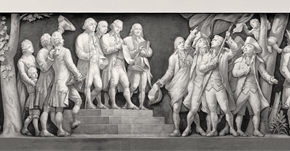
The arrival of Italians to America brought many experts in masonry/stonework. As many immigrants were from the Sicilian region, these artisans carried with them techniques that were inspired by Roman, Byzantine, and Baroque characteristics. Though recognition was not often credited to the Italian Americans working on the architectural projects, the Italian and Sicilian cultural influence shines on many buildings in major cities across the country. In what was called the City Beautiful Movement, a push for civic pride and engagement to be present in urban development arose in the United States (Yalzadeh and Blumberg). Through this movement, cities such as Washington D.C. and Chicago wanted to convey a certain authority and sophistication, that of which they chose to be inspired through the Italian Renaissance (How has Italian culture influenced America?). Design choices such as domes, arches, and pillars, the ties to Roman and Greek architecture, are present in many current well-known American buildings and city designs. For example, the design of the Capitol Building in Washington, D.C. was influenced directly by Rome’s classical temple form. The architect, Thomas U. Walter, was not an Italian American, though he adopted the Neoclassical and Rome style when designing the Capitol Building (Neoclassical). Regarding Italian Americans, two Italian American architects who, alongside another artist, painted the Frieze of American History in the rotunda of the Capitol Building. A rotunda, commonly within a dome, is a way to describe a round building or room, popular examples being the Pantheon in Rome, along with the rotunda in the Capitol Building. The 19 paintings by Constantino Brumidi, Filippo Costaggini, and Allyn Cox wrap around the rotunda, depicting important events that happened in American history. The Frieze has a grisaille style, which can be described as having an appearance of a sculpture through the use of monochromatic colors. Also by Constantino Brumidi in the rotunda, he painted the Apotheosis of Washington, which can be seen at the ceiling, reaching the sky. This painting depicts George Washington heading towards heaven, as scenes portraying different values such as Mechanics, Commerce, War, and others surround the first President of the United States (The Capitol Story). Though hired through commissions, these Italian American artists bring about great talent and Italian skill that decorates and helps make the Capitol Building as wondrous as it is.
Figure 1: The “Declaration of Independence” by Constantino Brumidi, Filippo Costaggini, and Allyn Cox. One of 19 scenes in the Frieze of American History, this image depicts the principal authors of the Declaration of Independence (The Capitol Story).
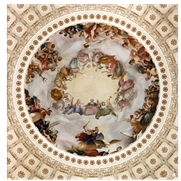
Figure 2: The Apotheosis of Washington. Painted in 1865 by Constantino Brumidi. Located in the eye of the rotunda in the Capitol Building, Washington, D.C. (The Capitol Story).
An example of renowned Italian American artisans include the Piccirilli brothers. The six Piccirilli brothers, who were all sculptors from Massa-Carrara, Italy, moved to New York with their parents and created a studio in the Bronx during the late 1890s. In New York, they helped with sculptures such as, “the lions outside of the New York Public Library, the pediment of the New York Stock Exchange, and the statue of Abraham Lincoln at the Lincoln Memorial”. While the works from the Piccirilli brothers are not necessarily made in an Italian style, nor were many of their contributions signed, they are responsible for the marvelous creations that people still appreciate today (Tola). The father, Giuseppe Piccirilli, was a sculptor who was trained at the Accademia di San Luca in Rome, a prestigious art academy. He also had two of his sons trained there as well, with Giuseppe teaching his sons what he learned in addition to the two brothers’ accomplishments (The Monumental Impact of the Piccirilli Brothers with John Belardo). When they moved to America, they brought an unparalleled skill that they were able to apply and contribute to the development of modern America.
The contributions of Italian Americans in the art world has been important in showing the Italian American experience. As stated earlier, those who came to America from Italy did not have much with them, but they had knowledge of history and culture, along with talents in many fields. So, to cultivate and keep their traditions alive, Italian Americans produce art to convey their feelings about the new world they are living in and, as years go by, they have grown up and generations have passed. By expressing themselves through art, they hopefully have been able to feel as if they are still grounded in their roots of Italian culture, while also living fully as Americans.
There are many pieces and artists surrounding the Italian American experience and the preservation of culture. For example, the Italian American photographer Anthony Riccio strived to convey the compassion of a photographer, and wanted to dedicate his work in showing the Italian American experience. His published books consist of photographs and stories about the lives of Italian Americans in his hometown in Little Italy. One of his books includes The Italian American Experience in New Haven: Images and Oral Histories (2006). Riccio took the time to document and record the Italian American experience, making a point to care and show importance for the lives of others (Serra and Abisognio). His care for others and wanting to tell their stories through written record and photography adds a weight to the emotion and sincerity of his work. As an Italian American himself, he knew how different and important each person’s story is, wanting to reflect the hope, pain, love, work, and more that reflect the lifestyle of an Italian American. His work serves as an impactful record of what Italian Americans are like, what makes them unique, and why they matter.
The term “diaspora” is a reference to people who have moved from their homes to a new area, more specifically a new country. The migration of artists who have moved across the world (or their ancestors) is also referred to as a diaspora. These artists are important, as they push boundaries and challenge the normal ideas. They do this by incorporating their perceptions of the new world they are living in with their own personal experiences, creating a unique perspective that calls for reflection of the audience. One example of this is in Joseph Stella’s piece, Smoke Stack, 1935 (Gatto). This piece is a depiction of the industrial scene when the United States was attempting to create another industrial era during the Great Depression. The dark colors and large smoke stack taking up the middle of the frame have been described as cathedral-like. Stella, an Italian American, pulls together the rough nature of the industrial lifestyle and adds dramatic themes tied to cathedral design, creating an intense piece showcasing how daunting and dark the American lifestyle can be (Smoke Stack). A lot of Italian Americans were working tough labor jobs during this time, and being able to have the lifestyle brought to life through art helps to convey the sacrifice that the Italian Americans made when settling in the United States.
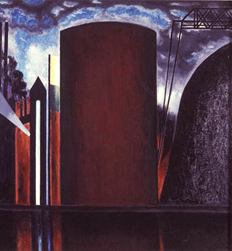
Figure 3: Joseph Stella, Smoke Stack, 1935. Dark shapes and colors depicting a smoke stack in an industrialized environment during the Great Depression (Smoke Stack).
In the second and third generations of Italian Americans, children of first or second generation Italians had to handle an ever-changing America, struggling to balance the ties to Italy and wanting to explore the new traditions they were surrounded by in America. An example of a second-generation Italian American is John Stango. His grandparents left from Foggia, Italy, arriving in the United States. As John grew up, he lived enriched in Italian culture, one example of this being his mom cooking traditional meals all the time, sitting at the dinner table for hours, and listening to music, which they loved the American artists with “Italian flavor” such as Frank Sinatra, Al Martino, and Connie Francis. His parents thought it was odd that he wanted to pursue a career in art, as they didn’t think he could make a living in that lifestyle (Tecce). This is a common reflection of Italian Americans feeling pressured by their parents to pursue a “successful” career, as the parents feel they moved to America for their kids to be as successful as they can, and in doing so want their children to pursue a career that would guarantee financial stability and success. Nevertheless, John worked hard in school and became successful, being featured in magazines, museums, galleries, and embassies. John’s artistic pieces contain many sports figures, but they also include many Italian Americans and patriotism, as his dad served in World War 2 (Tecce). John’s passion and dedication to working hard for his career shows the true drive for success that the Italians who immigrated to America arrived with. Through art, John is able to cultivate a collection of pride for his heritage through his creations and be proud of who he is. This helps lead to more recognition into Italian American heritage and showcase how important it is to express your pride for your culture.
Overall, Italian Americans have played a prominent role in the development of architecture, sculptures, artworks, and more in the United States. Through their sacrifices and the sacrifices of their parents, they were (and still are) able to work hard for their life in America, pursuing their talents. With many immigrants having been trained in the valuable skills of artisanship and masonry, they came to America with an abundance of skills and knowledge, propelling the artistic world in the United States. Moreover, Italian Americans are known for having a strong work ethic, wanting to work hard in everything they do. This is present in the hard work of John Stango, Piccirilli brothers, Constantino Brumidi, and Filippo Costaggini, as they had a passion for art and they were going to accomplish their dreams one way or another. The works by Joseph Stella and Anthony Riccio show a passion and emphasis on expressing Italian Americans and their culture, helping convey to the world their experiences and why they are important. All of these contributors to the art world are vital to helping make America what it is today, a place with renowned architectural buildings and an appreciation for the cultures and pasts of others, bringing new design aspects to increase the diversity of the architectural landscape and solidifying Italian American culture into America’s visual history.