Home

Our most recent interviews…

[yotuwp type=”videos” id=”CgqMwiLw8ms,-wpFSpNbDW0,74UFO1sBcD8,Pnbi6gOMfDU,84uLZ2pPebI,fkJIaeWklIk” ]

Our most recent interviews…

Upcoming Events

by: Janice Therese Mancuso

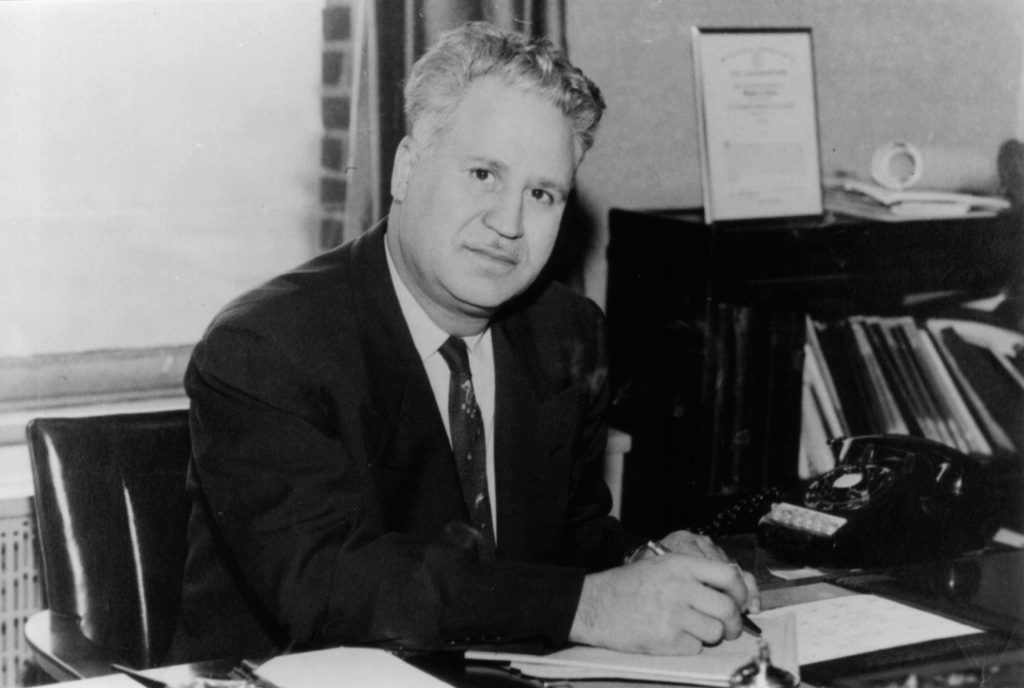
The Verrazzano-Narrows Bridge – often called the Verrazzano Bridge – is among the acclaimed bridges in New York, and often noted as one of the most well-known bridges in America. Not as well known is John N. LaCorte, a pioneer in advocating Italian American history and culture, and the man responsible for naming the bridge after Italian explorer Giovanni da Verrazzano.

LaCorte also worked towards increasing awareness of Antonio Meucci as the inventor of the telephone, recognizing Charles J. Bonaparte’s role in establishing the Federal Bureau of Investigation, and promoting the celebration of Columbus Day.

In May 1949, LaCorte founded the Italian Historical Society of America, with the mission of “perpetuating the names of those of Italian heritage who have contributed to the advancement of humankind and inspired others.” His inspiration came from a book on Italian American achievements, his business and personal experiences in the Italian American community, and his unique role of being a United States citizen, but growing up in Italy.

Born in New Jersey on July 4, 1910 to Italian immigrant parents, Giovanni Nazareno LaCorte was a toddler when his family returned to their home town of San Giovanni Gemini (province of Agrigento, Sicily). Giuseppe and Giuseppina LaCorte had immigrated to America in the early 1900s. Although they owned a farm and Giuseppe served as a local judge in the Sicilian village, Giuseppe sought a better life for his family – his wife and, at the time, a young daughter.

By the time Giovanni was born, Giuseppe had been considering moving back to Sicily. Life was difficult for immigrants in America in the early twentieth century and he was concerned about the negative treatment of Italian immigrants. He decided that his family would actually have a better life back in San Giovanni Gemini.

In Sicily, Giovanni was connected to his heritage and the culture of his ancestors; but as he approached his teen years – and in learning that he was a United States citizen – he longed to return to America. His parents did not support his move, but Giovanni was determined to make the trip. During his teen years in San Giovanni Gemini, Giovanni worked at various jobs as an electrician and carpenter, saving his lira for the journey back to America. In June 1929, Giovanni traveled by train to Palermo, and then boarded a ship for North America.

As an American citizen, he did not have to be processed at Ellis Island. He made his way to stay with a cousin in New Jersey, proud of his July Fourth birthday and Americanizing his name to John Napoleon; but he spoke limited English and finding a job was difficult. As he was making plans for his future, the Great Depression began with the stock market crash.

LaCorte’s greatest asset was his outgoing personality, and – as he learned to speak English – his charm and honesty were well received. He was a persuasive salesman, at first selling pencils and shoelaces on street corners, then selling vacuum cleaners, and later refrigerators, door-to-door. He knew his largely Italian immigrant clientele, and he knew that demonstrating the products would appeal to their needs.

Over time, LaCorte began to sell insurance policies, and when he married in 1937, he and his wife Marion, started an insurance agency. Now successful in business, LaCorte began to focus on Italian American history and culture. Having seen the negative news and representations of Italian immigrants and Italian Americans, he wanted to educate the immigrants and others in the community about the great accomplishments to society made by those of Italian heritage. After reading Four Centuries of Italian American History by Giovanni Schiavo, LaCorte was motivated to establish the Italian Historical Society of America in 1949, an organization that would counteract the harmful stereotypes.

Through his efforts, in 1952 the fully restored monument of Giovanni da Verrazzano was reinstalled in Battery Park, NYC; in 1961 the Charles J. Bonaparte memorial monument was presented to the U.S. Department of Justice; in 1971 the Columbus Statue was installed in Columbus Park in front of the State Supreme Court Building in Brooklyn, NY; and in 1989 the Antonio Meucci memorial was installed in Meucci Triangle in Brooklyn, NY.

His greatest accomplishment, though, was his advocacy in naming the Verrazzano-Narrows Bridge, officially opened in 1964 connecting Brooklyn and Staten Island over the Narrows. Verrazzano was the first European to explore the area, and LaCorte felt Verrazzano should be honored. It was through LaCorte’s diligence – opposing discrimination, presenting historical information, attending numerous meetings, and challenging political disputes – that the bridge today honors the Italian explorer.

After more than forty years of supporting Italian and Italian American history and heritage, John N. LaCorte passed in November 1991. He left behind the legacy of an historical foundation rooted in hundreds of years of Italian and Italian American history and committed to educating all. In October 2004, a memorial monument dedicated to LaCorte was unveiled in John Paul Jones Park. Located in Bay Ridge on the southwest tip of Brooklyn, overlooking the Narrows and with the Verrazzano Bridge in the background, the monument – crescent-shaped from pink marble – is inscribed Inspiratio per Exemplum, “Inspiration through Example.”

Today, under the direction of LaCorte’s son, John J., the Italian Historical Society of America maintains an online data base of Italian and Italian American history. In commemorating his father’s achievements, John notes “I came to appreciate his work later of course and have sought to perpetuate the memory of his efforts and contributions. Having the monument in his honor installed in Bay Ridge was a crowning achievement I am proud of.”

By: Caden Davis

When one commonly thinks of Italian food, they most likely will picture the classic spaghetti and meatballs, pizza, or lasagna. The more well versed may even refer to testaroli and pizzells. However, it is unlikely that one’s first thought would be the effect that the food has on people. While it isn’t always noticeable, one of the largest symbols of Italian culture is its people’s food. It had been imprinted in the minds of Americans through branding and movies. Almost every jar of pasta sauce at the supermarket will have a mustached man or a box of pasta will have a beautiful wheat-holding woman. In addition, the movies have made it expected for a pizza shop to always be run by an Italian dad and his sons. While these stereotypes might not always be true, it is indisputable that a clear-cut connection has been made and food has been one of the defining features of Italian culture. In an attempt to better understand all of the further implications of this fact, I examined both the positive and negative effects of this relationship. I also analyzed movies we watched in class and interviewed three generations of Italians in my family to see if attitudes regarding this topic were at all altered. Overall, this essay will explore how food has served as a conduit for the cultural connection among Italian Americans personally, historically, and through media representation.

The bond between Italians and their food provides a lot of cultural strength. In many instances, it is a way to keep family connected. Those who immigrated to America brought with them all the recipes from home. They use these to create moments with others to keep their Italian bond. Researcher and enthusiast of Italian cuisine, Lynn Rivard, strengthens this idea by discussing the importance of Sunday dinners. She explained that to Italians, Sunday dinners are, “…not just meals; they…are an opportunity for multiple generations to come together…” (Rivard, 3). While every Italian family may not follow this exact routine, the emphasis on family meals has always been made. My immediate family, though less Italian than my ancestors, always tries to eat together when we can. The ability to share food you’re proud of with the people you love is a necessity. The food has also helped groups of Italians during their early years in the United States. In class, we learned about the quick growth in the popularity of certain dishes such as pizza. It provided Italians with a foothold in this new country. In the land of dreams, they were given an advantage. In their difficult time of discrimination, this was a very important shift because it allowed them to own more businesses and prove themselves as Americans as well as Italians.

While Italian food helps contribute to the definition of the culture, this was not always a positive thing. When Italians first came to America, the natives were wary of these new customs. As many people are when major changes have happened throughout history, they were instinctively against anything other than the norm. Italians were ridiculed for factors such as their garlic smell. Whether it was from cooking or eating it, many were called names such as “garlic-eater”. This became a derogatory term for Italians that were disliked by Americans. This was a hard moment because this simple smell had always been accepted in Italy. It posed an unfortunate situation for the older generations where they were almost expected to be embarrassed of something their family had always done. In this instance, the link between Italians and their food was used against them just because it was an easy trait to point out. On a different note, Italian food was also influenced by American culture. While the idea of a melting pot is good in theory, at times it was taken too far to the American side. Many took Italian food and attempted to change it in a way they thought was better. As will be discussed later, this alteration of their original recipes was taken by some as a risk to lose their origins.

Throughout this course, we examined many different movies that tackled different struggles of the Italian American. The idea of Italian cuisine being Americanized was greatly shown in the movie “Big Night”, by directors Campbell Scott and Stanley Tucci. In this movie, Italian brothers Primo and Secondo try to navigate opening an Italian restaurant soon after immigrating to America. As they struggle to find business, the brothers find that other Italian restaurants in their vicinity are much more successful. They are struggling to keep up because Primo is refusing to alter any of his recipes from their Italian origin. For example, at the beginning of the movie he refuses a woman spaghetti and meatballs because in Italy the dishes were never prepared together. Throughout the rest of the movie, arguments are had where Secondo wants to ignore the Italian aspects of the food and give the customers what they want. Their differences are shown in other contexts when Primo refuses to drive because he never had to in Italy. On the other hand, Secondo finds an obsession with sporty American cars. This contrast helps explain why their views on the food were so different. Primo misses his time in Italy and is trying to hold onto it by making authentic food. However, just as he tries to change by driving a new car, Secondo is dissociating from his Italian roots by fighting to Americanize the food. Near the end of the movie they make a pure Italian meal together and realize that its taste and ability to bring together their friends was more powerful than any money they could have made with the restaurant. This movie may highlight the struggle of Italian Americans, but most importantly shows the way in which they can reconnect with their roots. Despite Secondo’s identity struggles, Primo’s passion for their heritage helped preserve their Italian sides. It also gave Primo some comfort in this change because the food allowed him a way to maintain who he was before the move. They both continued to share the ways of cooking these foods to those close to them. By doing this, it allows the recipes, style, and culture to continue in their American connections long after they are gone.

Another movie that emphasizes family and food is “Tarantella”, by Helen De Michiel. The main character Diane has just lost her mother and travels back to New Jersey for the funeral. Once there, Diane realizes how far she has strayed from her Italian raised customs. While upset, a neighbor and family friend Pina takes her in to help her reconnect. She does this by helping Diane translate her family recipes to English and sharing her own personal gnocchi recipe. Diane did not have a very good relationship with her mother. Despite her missing the chance to connect in person, these recipes that were passed down to her represent a piece of her mom that she can always have. Pina takes this a step further by contributing some of her family recipes and customs as well. This is a great representation of the Italian view of family. Just because they are not related by blood, both Pina and Diane treated each other as family. Family is seen not just due to who you come from, but instead who you care about. As a way of showing their new familial connection, Pina passes down food related customs. As with many Italians, this has become a strong way to keep their ties together as more generations come and go.

One of the most important examinations of this topic is how these views change between each generation in an Italian family. Factors such as where someone grows up, those in their vicinity, the amount of Italian blood, and much more can all affect someone’s feeling of cultural identity. To analyze the effects of all these differences, I interviewed my 2nd generation grandpa, 3rd generation mom, and 4th generation self. I started out by first asking everyone to provide one word that came to their mind when I mentioned Italian food. In order from oldest to youngest, we stated the words “sauce”, “comfort”, and “family”. It was interesting to me to find that my grandpa, being the most Italian of us all, would not refer to a more emotion provoking word such as my mom and I. I believe that the further down the bloodline I went, the more sentimental we became when thinking of the food. This could be due to the rarity of it. While he grew up eating this food each day, I correlate it more so with family events and gatherings. While this may not be applicable to all Italian Americans, it stands to reason that the food means more when it can be tied to specific events.

These interviews were a nice moment for my family members and I. We found many similarities in the foods we liked and some of our fondest memories around them. I found that my grandpa always looks forward to our Christmas Eve lasagna, while my mom never missed a family reunion calamari dish. While some of our ideas are different, they all show that to us food means family and family means food. This idea is especially important when the idea of cultural pride is questioned. While all my family members said they were proud to be Italian, my grandpa’s first statement was, “First off, I’m American.” While this doesn’t mean he is not satisfied with being Italian, it shows a bit of separation. This may have been due to his childhood. Being Sicilian, he had a darker complexion and was often discriminated against as if he was African American. As a teenager in the 1950’s and 60’s, he was often not allowed in public pools. This may have risked his appreciation for his culture, had his Italian community not still been receptive to him. Growing up in Wellsville, Ohio meant that he lived closely to many Italians from different regions of the country. They always allowed him around and provided an aspect of his heritage that he appreciated. When telling me stories of his younger years, he didn’t focus on the negative parts as much as the great meals shared with him. Every holiday and special event was reason for a celebration. Sharing great food with people who were kind to him provided a reason to love being Italian. My mother and I were very lucky to not have the same struggles as him. Through the use of family meals, my grandpa was able to pass down the traditions that my mother and I still carry on.

After a deep-dive, it has become apparent that there is more to Italian food than just a simple meal. Throughout history, it has conjured many different feelings to Italian Americans. To some, it meant a positive identity and chances at entrepreneurship in a new country. At times this identity was used against them. Their association to Italian food was sometimes made to have a negative connotation. Furthermore, our focus on movies during this class opened my eyes to more specific circumstances. Many films explored how characters dealt with their Italian identity upon living in America. While food was not always the focus, it existed as a common trope to remind the characters of where they came from. One of my most important examinations was looking at how these views differed between generations. Interviewing three generations of my Italian family gave insight to how views changed or stayed consistent depending on our ages and degree of ethnicity. It was eye-opening to see the struggles that my grandpa endured due to being Italian. It was also unexpected to see the differences in some of our family experiences. No matter what though, we all had fond memories of our family meals. They always symbolized a bond between us and stayed consistent despite everything else going on. To us and all other Italian Americans, the food we eat is a vessel. In the end it’s not the type, amount, or even taste that matters most. The most important matter is that it has never failed to bring us together and provide an identity that we are always proud of. I plan to use this tradition to show my children and all to come where our family is from and why we should always embrace it.

by Collin Carroll

America is a country of Immigrants. For centuries, families and individuals have been
immigrating to the United States in search of new opportunities and a path to a better life. Some
of the largest groups to make this trip were Italian and Irish immigrants. While their cultural
traditions, languages, and religious practices differed in many ways, these two communities
shared a common experience: the effort to try to find their way in a new and changing world.
Much of the history of these two groups has been extremely intertwined. They both worked in
blue-collar jobs and had many religious similarities and differences. Yet they understood each
other’s cultures over time through shared hardship, mutual support, and a growing American
identity.
Both Italian and Irish immigrants faced harsh realities upon arrival. The Irish, fleeing
famine and poverty, were among the first to be met with fierce discrimination. The Irish differed
in some views regarding religion. They were viewed as inferior or racially discriminated for
being Catholic. Italians, who arrived a little later, encountered similar prejudice. Often
stereotyped as criminals or anarchists, they, too, were viewed with careful attention to detail, due
to their unusual traditions and unique culture. Despite these challenges, both groups developed
tight-knit communities centered around the church, neighborhood associations, and family ties.
What makes the Italian and Irish immigrant experiences so interesting is not only the
adversity they faced, but the way they adapted and evolved, sometimes as two communities
coming together as friends and sometimes as rivals. In certain cities, especially in the Northeast
and Midwest, Italian and Irish neighborhoods were adjacent, even overlapping. Some families
were able to form relations across the ethnic lines, while others stayed separated due to reasons
of religion, culture, community, tradition, etc. Religion, particularly Catholicism, played a
significant role in both dividing and uniting the two groups. The Churches in the community
became a focal part of the community and caused much communion and separation.
In this paper, I tried to understand these relations better through the personal stories of
my grandfather. My grandfather, who is a third-generation Irish American, grew up in an Italian
neighborhood with few other Irish families. His stories offered me a unique view of the
friendships, the rivalries, the shared meals, the church festivals, and how these relationships
changed from one generation to the next. By focusing on his stories of the community, culture,
religion, and family, I hope to capture the true relation of immigrant life in a way that textbooks
can’t seem to capture.
I asked my grandfather questions based on religion, community, tradition, and relations.
The first question that I asked was about how the two communities interacted with each other
over his time growing up. Being a predominantly Italian community, my family were the

outcasts for the most part. It later came out that their neighborhood would complain that an Irish
family was moving next to them. He would talk about how he feels that the neighborhood is
starting to go downhill and that it will keep trending in that direction. My grandpa then told me
about other cases that he knew of in the surrounding area where people were being shunned
simply for being Irish. For example, there was a mayor in the neighboring town that was almost
ran out of town for being an Irishman, but these experiences were happening to several
nationalities around the area, and everyone had gone through it all at some point. Even though
there were said about my family by their neighbors who were Italian, my grandpa emphasized
that those same neighbors became their best friends. My grandpa would spend every day hanging
out with the kid, and the parents became great family friends. So much so that both sets of
parents are now buried next to each other. There were many jokes that started based on both the
Irish and Italian kids in the neighborhood, but neither group seemed to care about them. My
grandpa told me that it was the Italian kids who would start the jokes about themselves. The
tensions never seemed to be high, even with the stereotypes circulating. There was always an
immense amount of respect for both communities. My grandpa had nothing but amazing things
to say about the kids that he grew up with, and that they were truly hard-nosed kids. The only
times that he would see and/or notice the ethnic differences are when he would go over to the
family’s house. He told me about how they would always have the massive traditional Italian
dinners, and the grandparents would always be over, but growing up, that was always one of his
favorite parts. He loved the big meals and all the family values that he got to see. This aligns
with many of the stereotypes I have learned from taking Italian 222, but I was shocked to hear it
in such a positive light. Many of the films that we watched, and the different lessons, painted
these stereotypes as a way of hatred and prejudice. While yes, I acknowledge that both of those
points are very true, it was comforting and interesting to hear that those same stereotypes were
not always painted so poorly.
My grandpa then started to talk about some of the mafia ties that were in his community.
He said that it was an extremely prevalent thing in his neighborhood but it was never violent or
caused much harm to the community. He told me stories about the man who owned the candy
shop and how every time he would walk in there, he would see the owner sitting in the phone
booth inside the shop. The kids never understood what exactly was happening when they were
younger, because all they ever cared about was their candy. As he grew up, he started to learn
more and more about what exactly was going down. The owner was running a betting operation
for the mafia in the area, he would always be in the booth taking phone calls for different bets.
Several other businesses had ties to the mob. The barber would stop mid haircut to go take phone
calls and write down the bets, he was a bookie for the mafia. The garbage truck company was
another front. Although there was a very large presence of the mafia in the community, my
grandpa could only come up with two stories of people getting arrested, and it was never for bad.
In both cases, the men were caught running gambling operations and had different problems with
money. If any members in the neighborhood were violent, they were far and few between and
never bothered the neighborhood that much. I thought it was extremely interesting to hear about
these stories being real. I will see mafia stories in movies, where a certain image is painted about
them, and that there is always violence to follow. While what the mafia in this case was doing
was still illegal, my grandpa said that it never caused any harm to the neighborhood or the people
in it.

The next question that I asked was about the experiences that my great-grandparents had
with the two cultures being together. Their experiences were very similar to the next generation.
I feel that these two generations are when much of the discrimination, at least between the two
groups, started to vanish a little. It may have been a problem elsewhere, but where my family
was, it seemed to be disappearing. My great-grandparents never talked poorly about Italians, at
least in a serious context, and became very close with their neighbors who were Italian. My
grandpa’s uncle, who I was told tended to be a pretty racist man, even ended up marrying an
Italian girl. My extended family worked a lot in New York and would spend a lot of time in both
the Irish and Italian ghettos that were there. Both communities mingled a lot, and there may have
been problems here and there, but never anything with the whole community. I was told that
maybe if I went another generation back that there may have been some more prejudice, simply
due to the fact of the competition for jobs and opportunities, but the two generations that I got to
learn about seemed to be accepting and they got along splendidly.
Next, I asked about different community gatherings and or traditions he may have
experienced being in an Italian community, and how the relationship with the church was
between the two groups. I was told that there were never any unique traditions that were held in
Roselle Park. The typical feast days for different Italian Saints were celebrated and things of that
nature, but there weren’t many, if any, unique traditions. Many of the neighboring communities
would hold different celebrations and/or parties where there would be traditional food eaten and
some other traditions, but it was not anything like it is portrayed in pop culture. Now, with the
church, the Italians in the community were extremely devout Catholics, along with the Irish.
They never fought about different views in the church or ways to worship. Many Italian
holidays, feast days, etc., were celebrated, but others were not pushed down or shunned. Some of
the time, there would be a mass that was held in Italian, and my grandpa would often hear
confessions being given in Italian. He told me this story of a woman who would go to all three
mass services on Sunday. These stories were just to show how committed the Italians in the
community were to their faith. Not to try and illustrate discrimination against the Irish for not
being as committed. Once again, certain stereotypes are being played into, but not in a bad way.
There was never any discrimination because certain people would live up to the stereotypes. My
grandpa told me how he was always able to tell who the Italians were in the town, but not
because of their skin or accent or anything like that. It was due to the dress and how they carried
themselves; this was all said with laughter following because it was interesting to see the
stereotypes come true.
Looking back through the lens of my grandpa’s stories, the relationship between early
Italian and Irish immigrants becomes much clearer. This story is not simply about the hate or
love between the two communities, but about the way that they overcame the same adversity
while adapting to each other. These communities were shaped by shared hardships and distinct
traditions, often trying to balance cooperation and competition. My grandfather’s memories
reflect this: the moments of shared meals, going to mass together, working side by side, while
also going through the stereotypes and the jokes. Through it all, what emerged most clearly to
me is a story of resilience and community. Trying to find an identity in changing times but also
growing to accept a new culture and identity.

The values of community, culture, religion, and family were vital parts of the community
and truly helped them to thrive together. Churches were more than places of worship; they were
centers of social life, education, and family. Families leaned on one another across generations,
preserving customs while learning to accept other traditions, and there may have been rough
moments, but it flourished. And in the spaces where Irish and Italian lives crossed paths, they
shaped each other, attending each other’s events, sharing jokes, even marrying one another.
Though decades have passed, these stories still resonate. They remind us that the
American identity is not just one group of people but several stories and walks of life coming
together in pursuit of something more. Through my grandfather’s recollections, we can see how
cultural boundaries that once seemed so rigid and stiff can become a little blurry and accepting. I
hope that these same values that were shared and grew between these two cultures can continue
to give lessons to generations in the future, even if it is regarding cultures that are separate from
these two.

With insight from a student from Reggio Emilia University

by Alessandra Iarriccio

Italian School Culture: Stereotypes and Social Commentary

Italian schools are frequently characterized by certain enduring stereotypes, particularly among outsiders and even within the Italian population. Among the most common according to a student from a university in Reggio Emilia, Italy is the belief that Italian students are “not good at math.” Whether rooted in standardized test scores or anecdotal evidence, this stereotype reduces a diverse student population to a single academic deficiency. Additionally, there is a common misconception that many Italian students dislike school or view it as an unremarkable part of life, rather than a unique opportunity. This is compounded by claims that students don’t feel education is “special” or particularly empowering, possibly due to systemic underfunding, especially in Southern Italy. Outdated facilities and a rigid curriculum contributed to a general sense of apathy among some students.

Beyond the classroom, Italian culture is often stereotyped as highly social and even gossipy. In schools, this may manifest as a tight-knit, talkative student culture where interpersonal relationships dominate the school day. While gossip has a negative connotation, it can also reflect a deeper value placed on community, storytelling, and the spoken word, which are long-standing Italian cultural hallmarks.

American Education Stereotypes: Too Much Choice, Too Little Depth?

In contrast, the American education system is often portrayed through the media as overly flexible but lacking in depth. One of the most persistent stereotypes is that American students “study everything but know nothing.” This idea suggests that while students in the U.S. are encouraged to explore a broad range of subjects and extracurricular activities, they may not master any of them. American schools are often seen as places where the social aspect overshadows the academic, with television shows and films reinforcing this image through scenes of pep rallies, school dances, and sport events taking center stage over classroom learning.

Another criticism levied at American schools is the belief that students can choose their subjects too freely, resulting in a lack of academic discipline or rigor. Though the American system allows students to tailor their education, some argue that it leads to lower academic standards or a disconnection from core knowledge areas. However, this flexibility can also be seen as a strength, fostering creativity and personal growth.

Cultural Attitudes Toward Education and Immigration in the U.S.

The way education is valued and implemented in each culture further illustrates their contrasts. In Italy, education is often seen as a structured, intellectual pursuit that focuses on memorization and classical training. This emphasis on tradition, however, can result in educational stagnation when resources are lacking, especially in rural or Southern regions.

In the United States, education is frequently tied to personal advancement and the “American Dream.” Students are encouraged to explore interests and pursue passion projects, and schools offer diverse extracurricular options. However, the system is not without flaws. Socioeconomic disparities mean that students from wealthier backgrounds often receive far better educational opportunities than their lower-income or immigrant peers. Language barriers, financial limitations, and cultural differences can all create roadblocks to success for immigrant families, echoing the challenges faced by early Italian-American communities.

Efforts to make education more equitable continue today, as schools work to implement inclusive curricula and provide additional support for students from marginalized communities. While progress is slow, the dialogue around educational justice has become more mainstream, helping to dismantle harmful stereotypes and uplift diverse voices.

Stereotypes of Italian Americans in the U.S.

Looking deeper into the history of Italian-American stereotypes reveals painful truths. During the early 20th century, Italian immigrants were widely viewed as unintelligent and unfit for meaningful contributions to American society. The reading “Mentally Inferior Immigrants” documents how Italians were often described as bad soldiers, incapable workers, or even dangerous individuals who needed constant supervision. It was believed that if not watched, they would harm themselves or become idle. One stereotype that has stubbornly persisted is the association between Italian-Americans and organized crime. While popularized by films like The Godfather, this stereotype unfairly ties an entire ethnic group to the actions of a minority. Such media portrayals have contributed to a cultural image of Italian-Americans as both loyal and violent.

These old biases continue to echo in modern stereotypes faced by other immigrant groups. For instance, contemporary Mexican immigrants to the U.S. are often painted with broad, negative strokes due to the actions of a few. Just as early Italian immigrants were labeled as gangsters, some modern immigrants are stereotyped as criminals, underscoring how quickly a culture can be misjudged based on isolated behaviors and media amplification.

Romanticizing or Vilifying? Cultural Stereotypes of Italians

Stereotypes about Italians extend beyond education and into social and romantic relationships. On one hand, Italians are often viewed as passionate and family-oriented which are viewed as positive traits. On the other hand, these same traits can be flipped into negative stereotypes, such as the “womanizer” for men or the overbearing nature of tight-knit families. Films like Marty challenge the notion that family is always a positive force. The protagonist, bound by his family’s expectations, finds that his personal growth is hindered by their interference. Similarly, The Godfather depicts family as sacred, yet it also warns that violating family loyalty leads to exile or even violence. This portrayal has shaped public perceptions of Italian families as simultaneously loving and dangerous, emphasizing a cultural dichotomy where loyalty is both a virtue and vice.

Conclusion

Stereotypes, whether about education, work ethic, intelligence, or family structure, reveal more about the cultures that create them than the people they describe. Both Italy and the United States have been subject to cultural caricatures that fail to reflect the diversity and complexity of their societies. While stereotypes about Italians may portray them as disinterested in school and overly romantic, and Americans as superficial in their studies or overly social, these narratives obscure the lived realities of students, immigrants, and families on both sides of the Atlantic. Understanding and challenging these stereotypes is a necessary step toward mutual respect, cultural appreciation, and more accurate representation. In a globalized world where cultural exchange is constant, examining our assumptions about education and identity helps build more empathetic, informed communities.


With insight from a student from Reggio Emilia University

by Alessandra Iarriccio

Education plays a crucial role in shaping young individuals and societies. While every country has its own approach to education, Italy and the United States have distinct systems that reflect their unique histories, values, and culture. By examining the structure in both Italy and the United States by speaking with a student from the university in Reggio Emilia, Italy, we can gain insight into the strengths and challenges of each system.

Structure and Levels of Education

One of the most notable differences between the Italian and American school systems is their structure. In Italy, education begins with “Scuola dell’Infanzia” or what we know as preschool. This lasts from ages six months to six years. This is then followed by “Scuola Primaria” or elementary school which lasts for five years (ages six to eleven). After elementary school, students attend “Scuola Secondaria di Primo Grado” (middle school) from ages eleven to fourteen. Upon completion, students choose a specific type of high school, known as “Scuola Secondaria Superiore”, which lasts five years and prepares them for either university or vocational training.

On the other hand, the American education system follows a more generalized structure. Children typically begin with kindergarten around age five, followed by elementary school, which lasts until approximately age eleven or twelve. This is followed by middle school, also known as junior high school, covering grades six through eight and then high school which goes from grades nine through twelve. Unlike Italy, where students must specialize early on, American high school students follow a broader curriculum with elective courses that allow them to explore different subjects before choosing a career path.

Curriculum and Specialization

Another significant difference between the two countries is how the students are expected to specialize in their studies. In Italy, students must choose their high school type at age thirteen or fourteen. Options for specialization include Liceo Classico (focused on Latin and Greek literature), Liceo Scientifico (science and math focused), Liceo Linguistico (foreign languages) and other specialized schools such as technical institutes and professional schools.The first two years of high school cover general subjects, while the final three years focus on the student’s specialization. This system allows students to develop expertise in a particular field before entering university or the workforce. However, it also places significant pressure on young teenagers to make career-defining choices at an early age.

 In contrast, American students follow a more flexible high school curriculum. While they must complete core subjects such as English, math, science, and history, they also have the opportunity to take elective courses in areas such as music, art, business, and technology. This flexibility allows students to explore their interests before committing to a specific field in college or the workforce. However, critics argue that the American system does not provide the same depth of knowledge as the Italian system, particularly in subjects like philosophy, classical languages, and rigorous mathematics.

Assessments and Graduation Requirements

Examinations and grading differ greatly also between the two countries. In Italy, students must pass an extensive Esame di Maturità at the end of high school in order to graduate. This exam includes written and oral components and is graded on a scale of 0-100 with a minimum passing score of 60. This exam is known for its rigor and can significantly impact a student’s university prospects. Oral exams are a common part of the Italian education system, even at the elementary level, which encourages students to develop strong verbal communication skills.

In the United States, students are assessed through a combination of assignments, quizzes, standardized tests, and final exams throughout high school. To graduate, students must earn a certain number of credits rather than passing a single national exam. While some states require students to pass standardized tests, such as the SATs or state-specific assessments, high school graduation is generally based on coursework performance. This system provides more opportunities for students to succeed, but it also means that educational standards can vary widely depending on the state or school district.

Higher Education and University System

University education in Italy and the United States also differs. In Italy. Universities are primarily public, and tuition costs are relatively low compared to American universities. A three-year Laurea Triennale or a bachelor’s degree is followed by a two-year Laurea Magistrale or master’s degree, with the option to pursue a Dottorato di Ricerca (PhD) afterward. Italian universities emphasize self-study, and there is generally little to no homework; instead, students prepare for oral and written exams that determine their final grades.

In contrast, American universities offer a wide range of private and public institutions, with tuition costs that can be prohibitively high. The American college experience is characterized by continuous assessment through assignments, essays, and group projects, along with a focus on extracurricular activities and internships. Unlike Italy, where lectures are the primary mode of instruction, American universities place a strong emphasis on interactive learning and participation.

Conclusion

While both the Italian and American school systems aim to educate and prepare students for success, their methods reflect differing cultural values and educational philosophies. The Italian system emphasizes early specialization, academic rigor, and oral assessments, fostering deep expertise but placing pressure on students at a young age. In contrast, the American system prioritizes flexibility, continuous assessment, and broad exploration, which can support diverse interests but sometimes lacks depth in certain disciplines. Understanding these differences not only highlights the strengths and weaknesses of each approach but also reflection on how educational systems can evolve to better serve their students in a globalized world.

Teresa Sanhueza. Provided by Teresa Sanhueza.

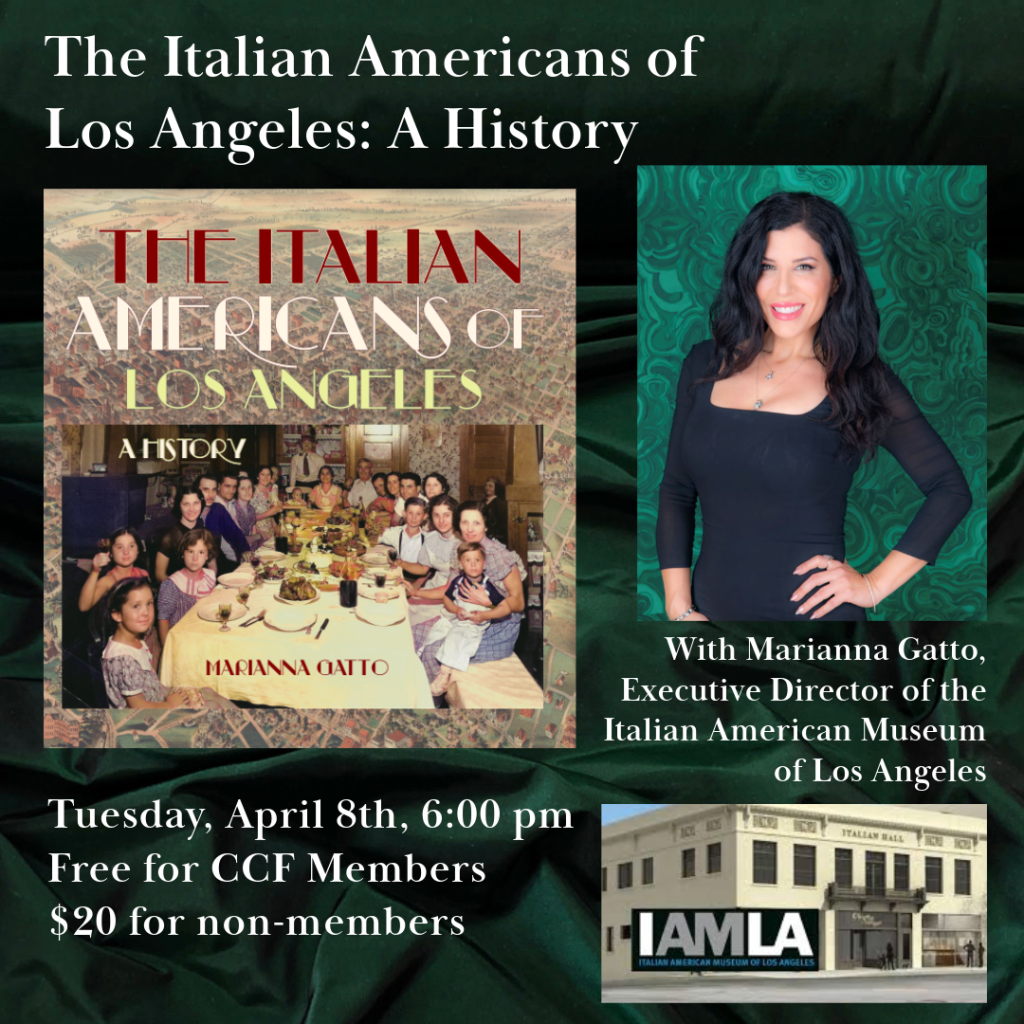
We are happy to spread the news on this very interesting event!

On April 8th, hear Marianna Gatto speak about her vibrant narrative which chronicles the Italian Americans of Los Angeles, a group that, although integral to every facet of the Southern California megalopolis for two centuries, has largely been overlooked in both local and Italian American histories. Based on meticulous research, this multidisciplinary study by historian Marianna Gatto is the first extended account of Italian Americans in the City of Angels. Artists and agriculturalists, dreamers and outlaws, pioneers and powerbrokers come alive in this sweeping work and provide important points of comparison for understanding the American mosaic. Over one hundred images, including many never before published, help illustrate this impressive multi layered history. 

Last year, on March 19th, four generations of family gathered on the corner of 118th Street and First
Avenue in East Harlem to honor Giuseppina Santo in a street co-naming ceremony. It was a day of
celebration, a loving tribute to a mother and grandmother, but it was filled with sadness. Just a few feet
from the busy intersection, Giuseppina Santo lost her life, a victim of arson; a crime that has never been
solved. Born in Cilento (in the province of Salerno), Campania in 1899, Giuseppina Costabile embodied her family name throughout her life. Southern Italian in origin, the name Costabile portrays the characteristics of being steadfast, reliable, and trustworthy; all traits that describe Giuseppina.
Giuseppina met Antonio Santo – a carpenter by trade who worked at her father Michele’s construction
business – and married in 1925. Antonio was a widower with three children, and Giuseppina was
committed to the role of wife and stepmother. The following year, their first child together, Paolino, was
added to the family. With limited opportunities for a better life in the village, Antonio traveled to
America.

Giuseppina Costabile’s Boarding Pass


In 1930, Giuseppina and Paolino arrived in America, settling with Antonio in East Harlem. At the time,
East Harlem was known as Italian Harlem, and with the largest conclave of Italian immigrants in
America, it was the first Little Italy. Within the boundaries of 96th Street and Third Avenue to the East
River and to the Harlem River north, around 100,000 Italian immigrants lived in the area, creating slices
of life in New York City that represented their former villages in Italy. As Giuseppina adjusted to her new life, she held on to her cherished Italian traditions; and her religious beliefs were the foundation of her character. She regularly attended Holy Rosary Catholic Church – where Mass was said in Italian – and was devoted to participating in the varied processions sponsored by the church. She was well regarded in the community for her compassion, kindness, and charitable deeds; and Giuseppina emerged as a positive influence in the neighborhood, becoming known as Josie.

Josie and Antonio with Caterina, Antonio, Jr., and Paolino. Circa 1938.


Josie and Antonio moved several times within the neighborhood, and had two more children, Antonio, Jr.
and Caterina. Antonio had worked as a laborer, but during the Depression, jobs were scarce and Josie took on the task of finding a way to increase the family’s income. She was proficient in hand crafting clothing and tablecloths for family and friends; and found a job in piecework, a very common practice in the garment industry at the time, where workers were paid for the number of pieces of product they produced. Over the years, the children grew – having their own children – and Antonio worked as a superintendent in the building where they lived. After his passing, Josie stayed in the apartment, her home filled with the treasures of her life – pictures of relatives, statues of saints, figurines, and crucifixes – and the voices of her grandchildren on their Sunday visits.

Josie with grandchildren Joe, Josie, and Gino, 1959.


Her grandson Joe Angielczyk (Caterina’s son) has fond memories: “First is the Sunday dinners as so
many cousins jammed into the small apartment [Josie had thirteen grandchildren.] …. Her cooking and her beautiful loving spirit as we arrived as she waited looking out her window overlooking First Avenue and waving. … The piecework and sewing machine and fabric … she worked over the Singer machine till her 70s when her eyes couldn’t do it anymore. … The bedroom with all the saints lined up on the dresser
drawers, votive candles next to family photos, the three holy crosses hanging over the bed rivaled any
church.” By the 1970s, much of the area had fallen into disrepair, and many tenants in the apartment building moved away. Now close to 80 years old, on an outing Josie was assaulted and left with bruises. Her family pleaded for her to move, but strong-willed Josie replied, “If there’s bad people here, let the police come take them. I stay!” As the neighborhood continued to deteriorate, Josie held firm. On February 27, 1984, three fires were set in the building, turning all her possessions into ashes, and taking her life. Her family was devastated, and so was the community. From her eulogy: “Her greatest asset and also the eventual cause of her demise was her strength; a will to survive. … She absolutely refused to leave it all, to escape like so many others did. … She was loved and cared for dearly by her immediate community. Her presence will be missed greatly by all whose lives she touched.” After investigating the cause of the fire, an arrest was made, but it was closed within six weeks. However, Josie left an indelible impression, one her grandson could not ignore. Her life was exemplified by doing the right thing, being responsible, and having faith; and Joe was inspired to become an advocate for her
legacy. In the course of his work, Joe learned that the case could be reopened. It was in 2004, but stymied
by conflicting reports it not only remains unsolved, but also prevented the cause of her death to be
brought to justice. Still, Joe was not deterred. With the resolute passed down from his grandmother, he approached the City Council requesting the corner of the street where Josie lived for thirty-five years be co-named in her honor. Initiated in 2018, the task took six years and included support from the local community, neighboring churches, and Italian American organizations: a petition signed by almost 200 local residents, and assistance from the Little Italy Shrine of San Gennaro, The Church of the Most Precious Blood, Figli di San Gennaro Society, and the Sons and Daughters of Italy, Joseph Petrosino Lodge.

Local supporters Bill Cardenuto and Emily DePalo with Josie’s grandson Joe Angielczyk.


On the anniversary of her birthday in March 2024, Joe and his family paid tribute to Giuseppina Costabile
with the installation of the street sign “Giuseppina ‘Josie’ Santo Way.” It is an acknowledgement not only
to Josie, but also to all the immigrant women who endured the challenges of starting a new life in an
unfamiliar country, in providing emotional support to their families and neighbors, in adding value to
their community, and in persevering through the difficulties they faced. Josie’s legacy lives on, but not just for those who stop at the corner and look up at the sign. Several years ago, her great-granddaughter, Francesca, wrote a composition about her heritage for a fourth-grade class assignment. She recounted the events – told by her father, Joe – about Josie and her tragic death, but ended with an optimistic and thought-provoking statement, something Josie would say, “Respect everyone, as everyone has their own story!”

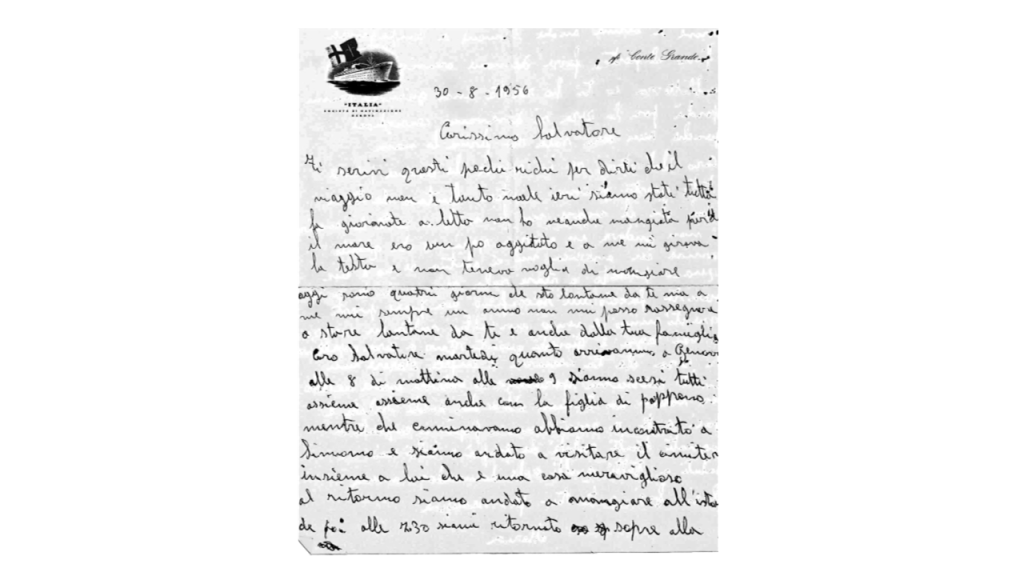
I am pleased and honored to share with our readers another document from the past, a letter written in the August of 1956 by Maria, a girl from Mugnano del Cardinale (Avellino, Italy) who was migrating to the United States with her parents. Maria wrote this letter to Salvatore, her fiancée and future husband, and she told him about the travel by boat.

This letter is touching because Maria was very sad to leave Salvatore behind, but of course she had to follow her family in that travel towards a better future in America. and more specifically in Cincinnati, where the family settled. Unfortunately, Maria experienced seasickness throughout the travel, a circumstance that certainly did not improve her mood.

Aside from the personal story, the letter provides important historical details about the travel itinerary and logistics. Thanks to an online research, I was able to trace the ship mentioned on the header: the Conte Grande, a transatlantic vessel build in 1927 who travelled from Genoa to Naples to New York. From 1932 to 1940, the company that owned the ship, “Lloyd Sabaudo”, merged with the company “Italia Flotte Riunite”, and Conte Grande was destined to routes from Italy to South America. When Italy entered in the Second World War in 1940, the ship remained stuck in Santos, Brazil, for two years, from 1940 to 1942. During that time the crew worked in hotels and restaurants, until the relationship between Brazil and the countries of the Axis (Germany, Italy, and Japan) deteriorated. In 1942 Brazil entered the war with the Allied Forces against Germany and Italy; the ship was sequestered, and the members of the crew were arrested and sent to San Paulo.

In 1942, the Conte Grande was sold by Brazil to the United States; with the new name USS Monticello, the ship was used as a troop transport until the end of the war. In 1946 it was retired from service. The story of this ship, however, was not finished. Following a confidential negotiation between President Truman and the Italian Prime Minister Alcide De Gasperi, the U.S. returned the ship to Italy, and re-took its original name Conte Grande. The ship started again to carry passengers from Italy to America in 1947 until 1962, when it was demolished in La Spezia, Italy.

Here is the translation of the letter made by me. Many thanks to Teresa Dugan for allowing us to make this letter available as part of the Italian American Collective project.

August 30, 1956

Dearest Salvatore,

I am writing you these few lines to let you know that the travel is not that bad. Yesterday we spent the entire day in bed. I didn’t even eat because the sea was a little rough, my head was spinning and I did not feel like eating.

Today it is four days that I am far from you; to me it seems like a year. I can’t accept to stay far from you and from your family. Dear Salvatore, on Tuesday we arrived in Genoa at 8 in the morning. At 9 we all went out together, even the daughter of Pappano. While we were walking, we met Simone and we went to visit the cemetery with him, and it was beautiful. On our way back we went to eat at the restaurant, then at 7:30 we were back on the ship and Simone walked us to the dock. Maybe tomorrow you will receive my letter that I wrote the day before; I had to send it because the ship stops for only an hour.

Dear Salvatore, if I knew that I had to go through all this, first that I miss you and then that the sea makes me sick, I wouldn’t have gone to America even if I had to die. I hope that when I am in America I will get used to it, because otherwise it will be a problem to be alone without you. If I resist I will make a sacrifice, so I hope this year passes quickly and I come back again with you all. Today is Thursday, when I was home [in Italy] I was waiting for you to come [on Thursdays], but now I have no hope. I would like to be a bird to fly to you, even only to say hi and kiss you and mom and dad and the in-laws. Greetings from my dad to all of you and say hi to those who ask about me.

Kisses kisses. Yours Forever

Maria

Source: https://it.wikipedia.org/wiki/Conte_Grande_(transatlantico)